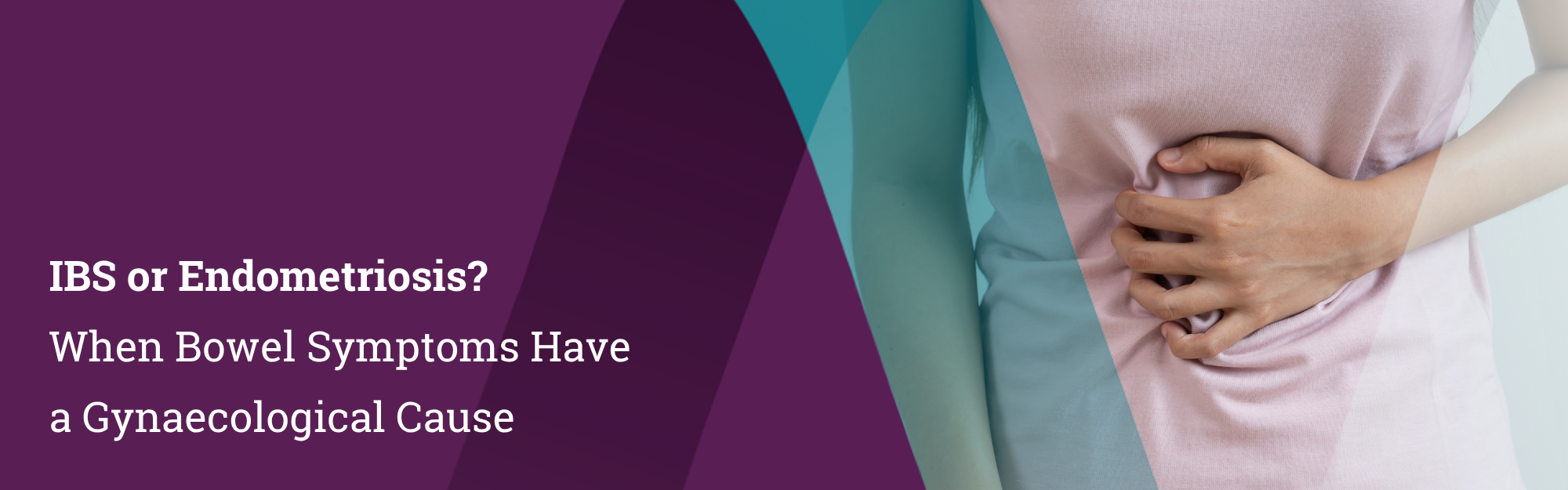
If you live with bloating, cramping and unpredictable bowel habits, it is easy to assume the cause is IBS. However, for some women, these gut symptoms may be linked to endometriosis – and the two conditions can also coexist, with overlapping and easily confused signs.
Recognising when bowel symptoms may have a gynaecological cause can be a crucial step towards accurate diagnosis, more effective treatment, and lasting relief.
Consultant Gynaecologist Miss Silvia Carta and Consultant Gastroenterologist Dr Rishi Goel explain how gastrointestinal disorders and endometriosis overlap, how to spot the clues, and when it may be helpful to seek specialist input from both specialties.
When your gut and your gynaecology tell different stories
Many women describe a familiar pattern: abdominal bloating, cramping and bowel changes that worsen in the days before a period, sometimes alongside deep pelvic pain or pain during sex. Dietary changes may help a little, but symptoms keep returning – often month after month.
Because IBS and endometriosis share many symptoms, it is understandable that the gut is often investigated first. However, when symptoms follow a cyclical pattern linked to menstruation, or persist despite IBS-focused treatment, it is worth asking whether something else like endometriosis could be contributing.
IBS explained simply
Irritable bowel syndrome is a long‑term condition affecting how the gut works rather than how it looks on scans or endoscopy. The bowel becomes extra sensitive and may not move food along in a smooth, regular way, with an involvement of the brain–gut axis. People with IBS typically experience a combination of:
Abdominal pain or cramping.
Bloating, distension, and a “swollen” feeling in the abdomen.
Diarrhoea, constipation, or alternating patterns.
Urgency or a feeling of incomplete emptying.
Symptoms often fluctuate and may be triggered or worsened by particular foods, stress, anxiety or hormonal changes. Tests such as bloods, stool checks and sometimes colonoscopy are usually normal, which can be reassuring in ruling out serious diseases such as inflammatory bowel disease and cancer. IBS is common, especially in young women, and while it is not dangerous, it can significantly affect quality of life.
Endometriosis and bowel symptoms
Endometriosis occurs when tissue similar to the womb lining grows outside the uterus. It is most often found on the ovaries, fallopian tubes and pelvic lining, but can also involve bowel, bladder, and, although rarely, present itself elsewhere in the body.
This tissue responds to monthly hormone changes, thickening and breaking down with each cycle. But because it has no easy way to leave the body, it builds up and can trigger inflammation, scarring, endometriomas, and bands of tissue called adhesions.
When endometriosis affects areas near the bowel, it can cause:
Deep pelvic pain and severe period pain.
Bloating and lower abdominal discomfort.
Pain with bowel movements, especially around menstruation.
Constipation, diarrhoea or alternating patterns that present very much like IBS.
Symptoms are often cyclical at first but may become more persistent over time. Fatigue, pain during sex, and fertility difficulties are also common in severe cases.
Why IBS and endometriosis feel so similar
Both IBS and endometriosis involve heightened nerve sensitivity within the abdomen and pelvis. When nerves become hypersensitive and over-responsive, even normal sensations – such as bowel movement or gas – can feel painful.
That is why both conditions can cause:
Cramping or twisting abdominal pain.
Bloating and visible abdominal distension.
Nausea, changes in appetite and altered bowel habits.
Flare‑ups triggered by stress, tiredness or hormonal changes.
Research shows women with endometriosis are significantly more likely to also be diagnosed with IBS and vice versa, reflecting both true overlap and the difficulty of distinguishing between the two. None of this means your symptoms are “in your head”, but it highlights how interconnected the gut and reproductive system are.
Clues that help differentiate IBS and endometriosis
Many women sit somewhere in the middle, experiencing signs of both conditions, so symptoms alone don’t give a perfect answer, but certain patterns can offer helpful clues.
IBS is more likely when:
Tummy pain is clearly linked to eating or specific foods, and often eases after opening your bowels.
Bowel habit changes (diarrhoea, constipation or both) are your main concern, with less emphasis on pelvic or cyclical period‑related pain.
Symptoms were present long before periods became painful, or they are similar in pattern to other family members with IBS.
Bloating and discomfort are present throughout the month without a strong cyclical pattern.
Endometriosis is more likely when:
Pain clearly worsens in the days before your period and during menstruation, and may continue afterwards, with a pattern that repeats every cycle.
You have deep pelvic pain, painful periods that interfere with daily life, and your symptoms significantly improve or resolve away of the bleeding episodes.
Pain during sex.
Bowel symptoms, such as pain on opening your bowels or a sense of pressure, are noticeably worse around your period.
On top of the above symptoms, you have been trying to conceive for some time without success, or you have a family history of endometriosis.
Potential shared mechanisms between endometriosis and gastrointestinal disorders
As well as looking at symptoms on the surface, researchers are increasingly interested in why endometriosis and gut problems so often appear together. Understanding some of the shared underlying processes can help explain why pelvic and digestive symptoms are so closely linked in many women.
Growing evidence shows that endometriosis frequently coexists with gastrointestinal disorders, including functional conditions such as irritable bowel syndrome (IBS) and inflammatory bowel diseases (IBD) such as Crohn’s and ulcerative colitis. Large population-based studies found that women with endometriosis have an increased risk of developing IBD [ https://gut.bmj.com/content/61/9/1279 ], supporting the idea that shared inflammatory and immune-related processes are driving both conditions.
Similarly, pooled data from several studies indicate that individuals with endometriosis have approximately a two- to three-fold increased risk of IBS, and up to 40–50% report ‘IBS-like’ gastrointestinal symptoms. This overlap can make diagnosis more challenging due to the similar clinical presentations.
Researchers believe several biological mechanisms may underlie this association. Both endometriosis and bowel disorders involve chronic low-grade inflammation and immune dysregulation, with increased levels of inflammatory signalling molecules called cytokines. These substances are involved in both endometriotic lesions and intestinal inflammatory responses, and may contribute to increased gut sensitivity and altered gut–brain signalling – key features of functional gastrointestinal disorders.
Scientists are also increasingly looking for answers in the gut–microbiota–endometriosis axis, with evidence demonstrating that endometriosis patients often have an unbalanced gut microbiome, or dysbiosis, which can drive mucosal inflammation and impair the gut lining. It also shows that certain intestinal bacteria involved in oestrogen metabolism – collectively termed the “estrobolome” – may influence how much oestrogen circulates in the body and could therefore affect the hormone-driven inflammatory processes that underpin endometriosis.
More emerging studies, examining metabolic by-products from these bacteria, show an overlap between patterns seen in endometriosis and IBD, providing additional biological evidence for the frequent coexistence of gynaecological and gastrointestinal pathology.
Together, these findings support a shared neuro–immune–microbiome axis – in simple terms, a three‑way interaction between nerves, the immune system and gut bacteria that links endometriosis with both IBS and IBD. For patients, this helps explain why pelvic and digestive symptoms so often run together, and why a joined‑up approach between Gynaecology and Gastroenterology can be particularly helpful when planning investigations and treatment.
When to see a specialist
It is not always obvious which specialist to approach first, but you do not need to work this out alone – the important step is to seek help.
You may consider starting with:
Gynaecologist if pain is cyclical, pelvic-focused or affecting fertility.
Gastroenterologist if bowel habit changes or abdominal pain are the dominant concern.
At New Victoria Hospital, Gynaecology and Gastroenterology Consultants can work together, share information and coordinate your investigations to provide joined-up assessments and avoid fragmented care.
How IBS and endometriosis are investigated
Assessment usually begins with a detailed history: when your symptoms started, what makes them better or worse, how they relate to your periods, diet, stress levels, and bowel habits. Keeping a simple symptom diary for a few weeks can be very helpful.
Investigations may include:
Blood and stool tests to check for coeliac disease, inflammation, or infections.
Abdominal ultrasound or MRI.
Pelvic ultrasound or pelvic MRI to look at the internal pelvic wall, lower bowel, womb,ovaries and tubes and identify anatomical and macroscopic changes.
Diagnostic laparoscopy (keyhole surgery) to directly visualise and treat endometriosis when needed.
Endoscopy or colonoscopy to rule out inflammatory bowel disease, bowel cancer or other structural problems.
It is common for tests to be normal in IBS and in some cases of endometriosis, but that does not invalidate your symptoms. Clear explanations and next steps matter just as much as investigations.
Treatment: two conditions, shared goals
Although IBS and endometriosis are different conditions, the goals of treatment are similar: to reduce pain, improve daily function, and protect long‑term health.
Management may include:
Dietary and lifestyle adjustments.
Medications for pain, bowel symptoms, or bleeding regulation.
Surgery for endometriosis when appropriate.
When both conditions are present, combining approaches often leads to the best results.
Don’t just put up with it
Living with chronic bowel and pelvic symptoms can be exhausting and isolating. If your symptoms do not fully make sense, or treatments have only helped partially, it is reasonable to seek a broader, more integrated assessment.
At New Victoria Hospital, our Gynaecology and Gastroenterology Consultants can work together to assess and support women with complex, overlapping symptoms. Appointments can be requested online or by calling 020 8949 9020.